
Innovation Cowboys + Flows: The New Speed of Problem Solving
A recap from Cognite Impact World Tour Houston 2026, and how our teams are working as one to turn field experience, engineering context, and operational insight into practical digital tools


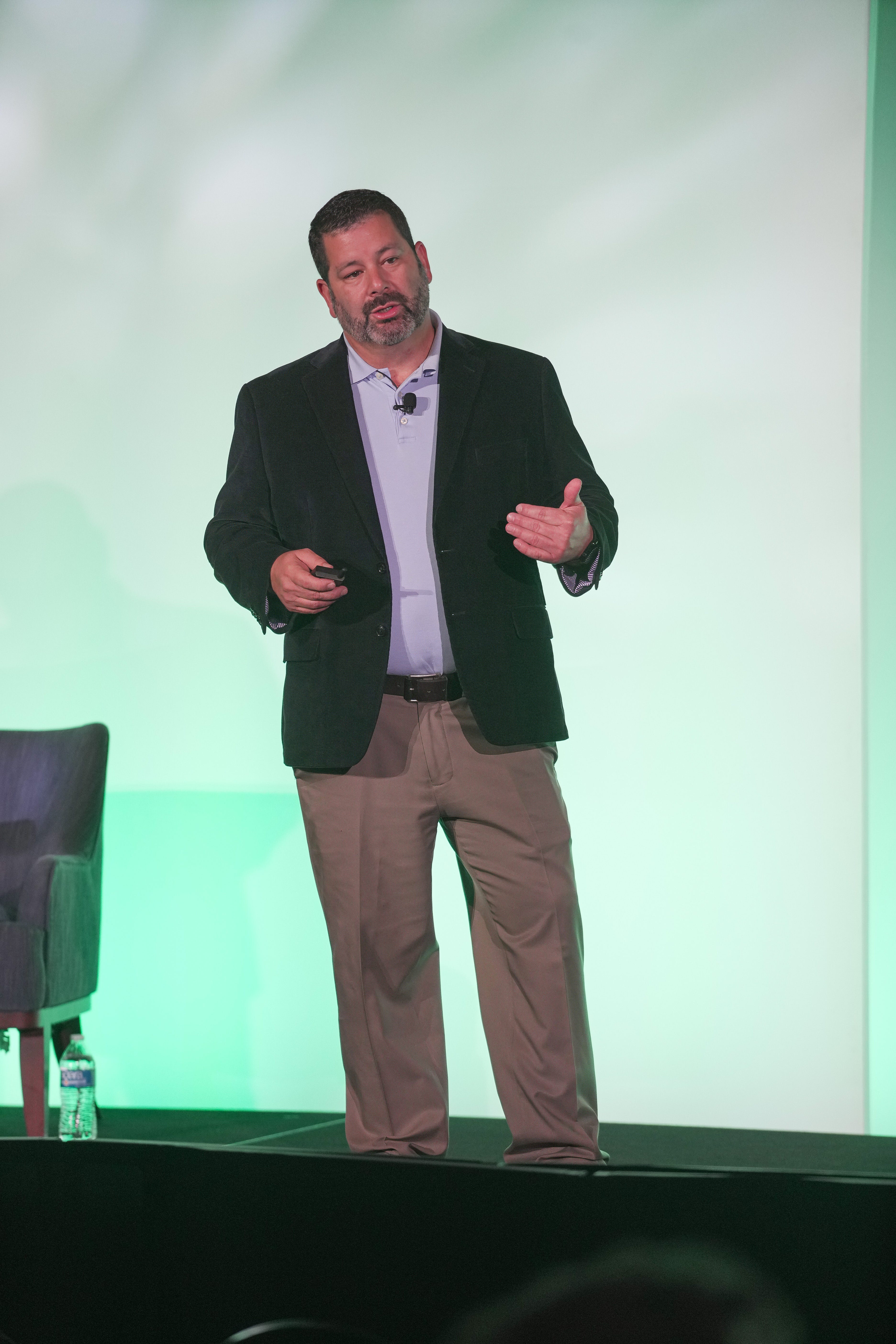
Last week at Cognite Impact Houston, we shared a story from our time working together at Hess. The presentation was called “We Built the Foundation, Now What?”
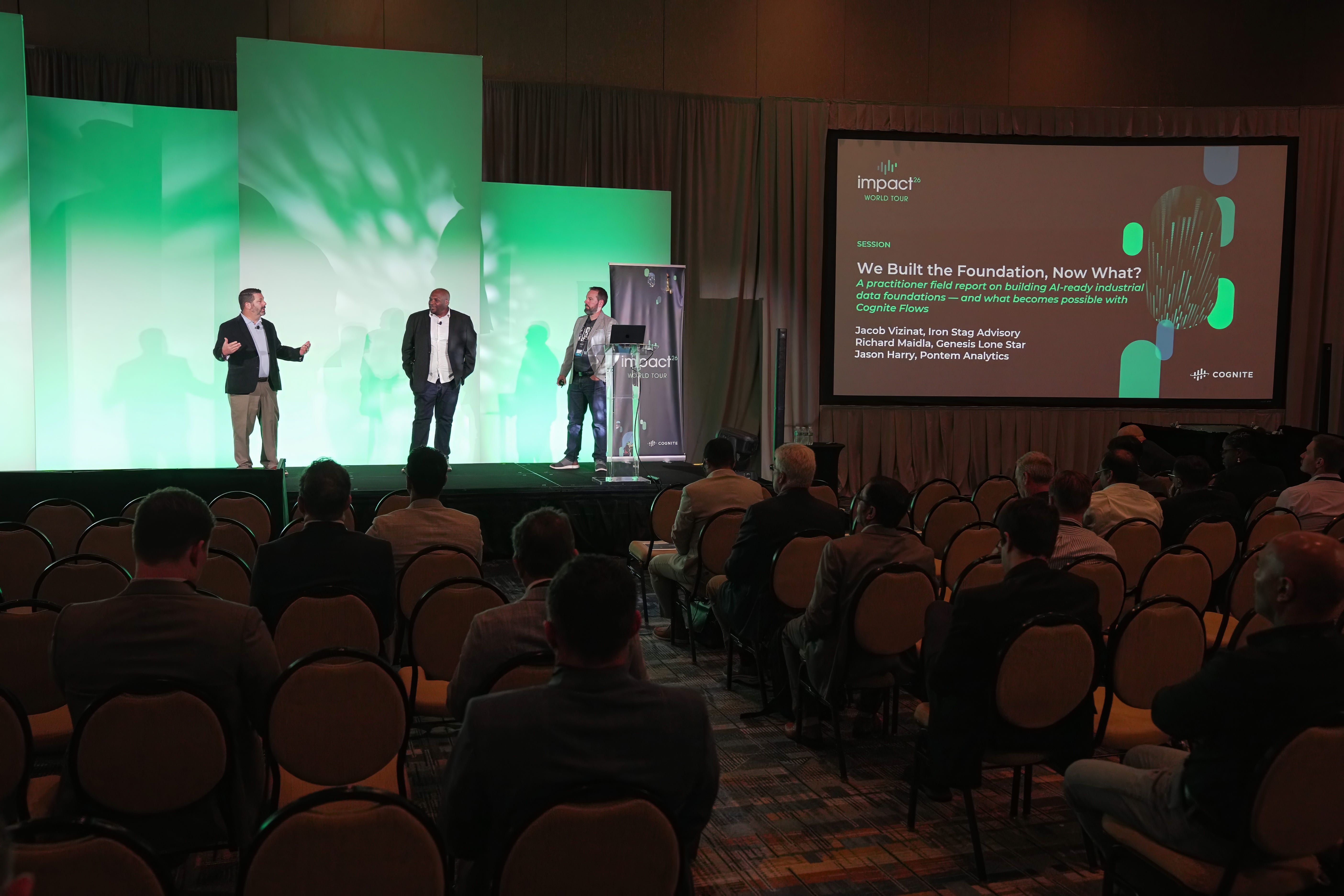
That title captured the central challenge: what should a company do once it has built the foundational layer of contextualized industrial data?
It was a great few days of networking, learning, and spending time with folks in the Cognite ecosystem of customers, partners, and providers.
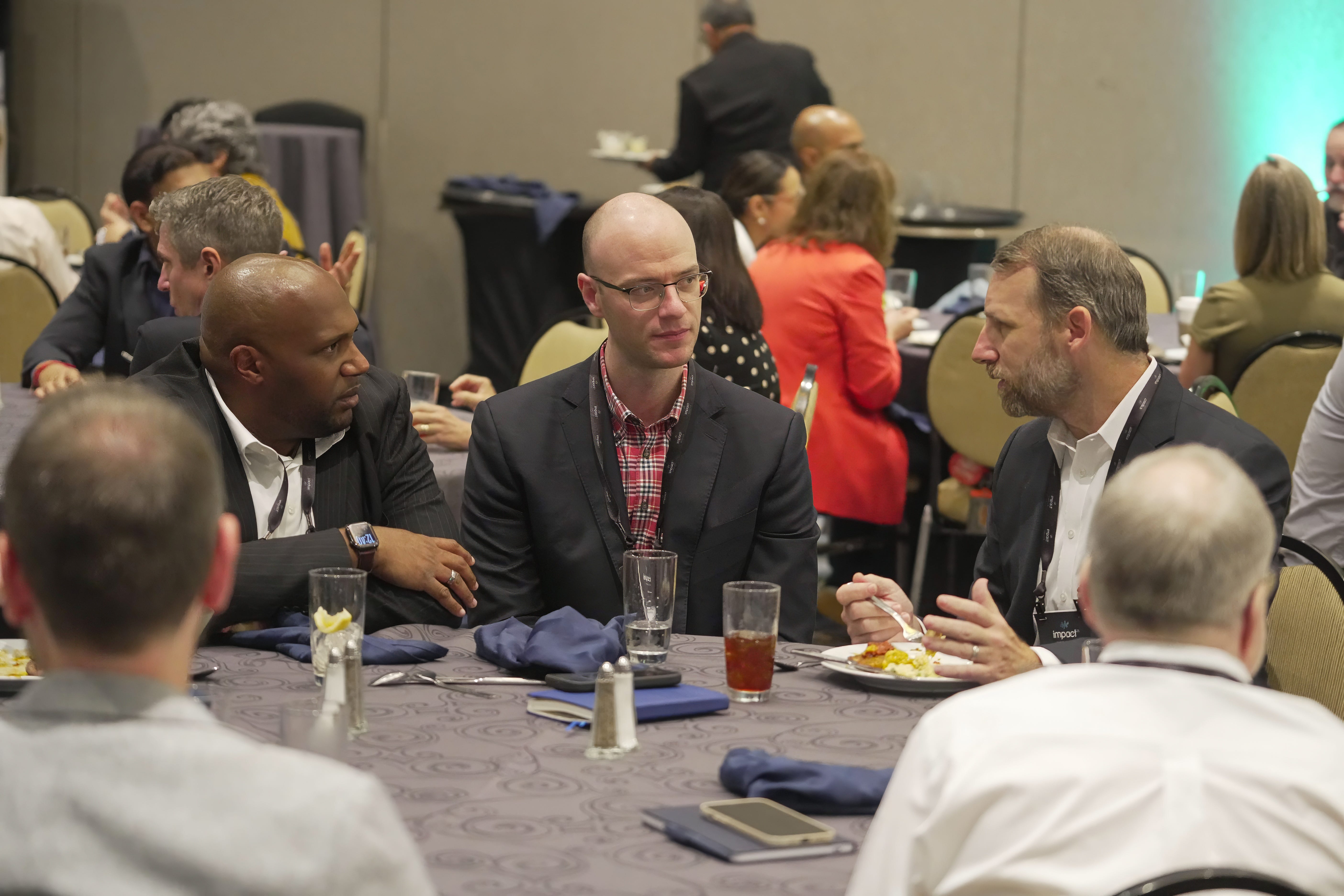
Throughout the day, there was a consistent message about the freedom companies have; to create the tools they need to run their business once they establish a solid data foundation.
Since the NBA Finals were going on last week, we could not help but make the analogy that the speakers before us were like Kobe throwing up the perfect alley-oop, and we came in like 2000 Shaq coming in to take it home with real, practical examples of how we used that same philosophy to run our business.

Bad analogies aside, the setup was real.
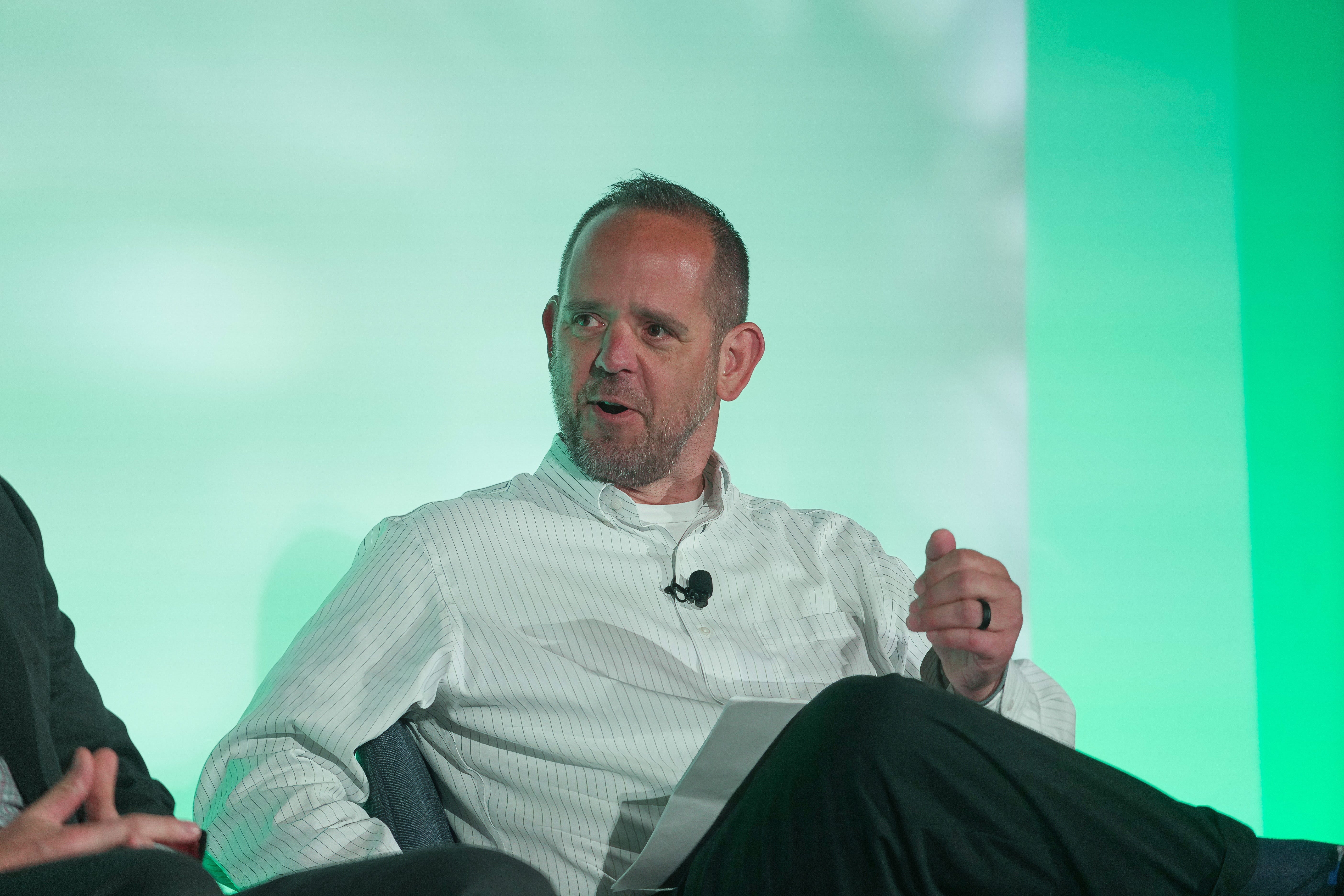
Paul Miller from Forrester laid out a strong value statement around Cognite: get the basics right, involve the frontline to identify real pain points, define the conditions of satisfaction with stakeholders, and find partners with strong technology, deep domain knowledge, and a shared outlook. Never lose sight of the human element!
Our colleague Adam Ballard joined a panel with ExxonMobil and International Paper. Adam talked about how he used Cognite to accelerate the same AFoF — Autonomous Fields of the Future — program in an onshore setting, optimizing daily routes and helping operators in North Dakota spend more time on meaningful work.
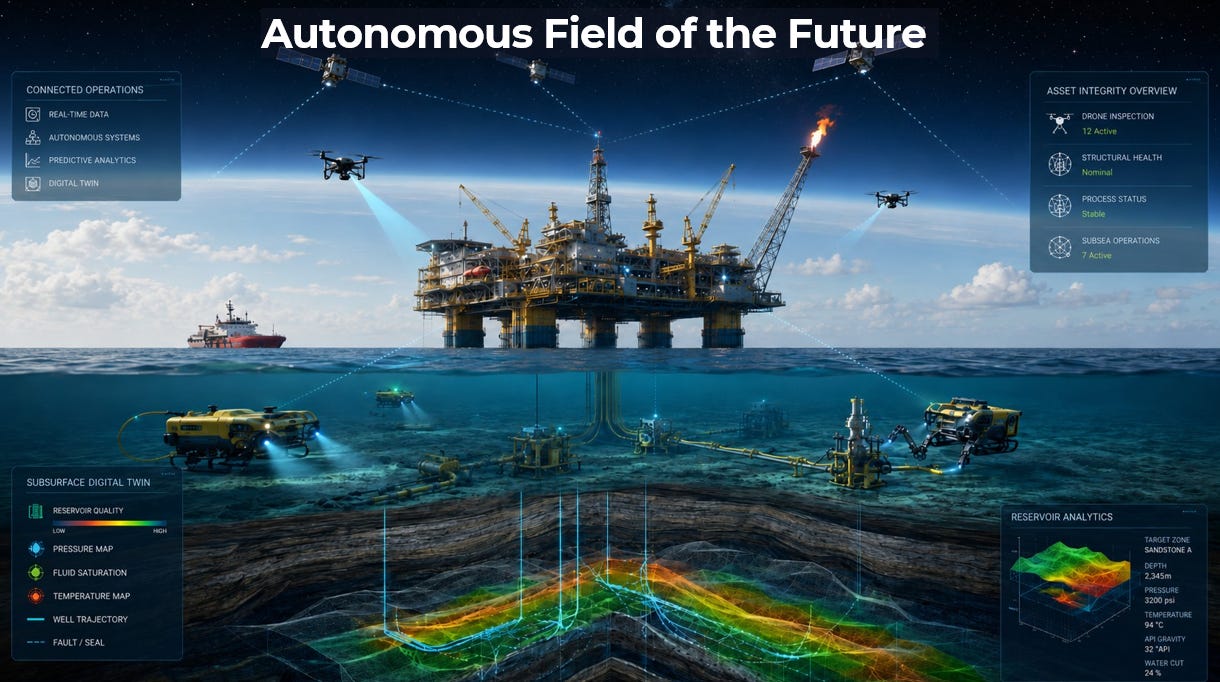
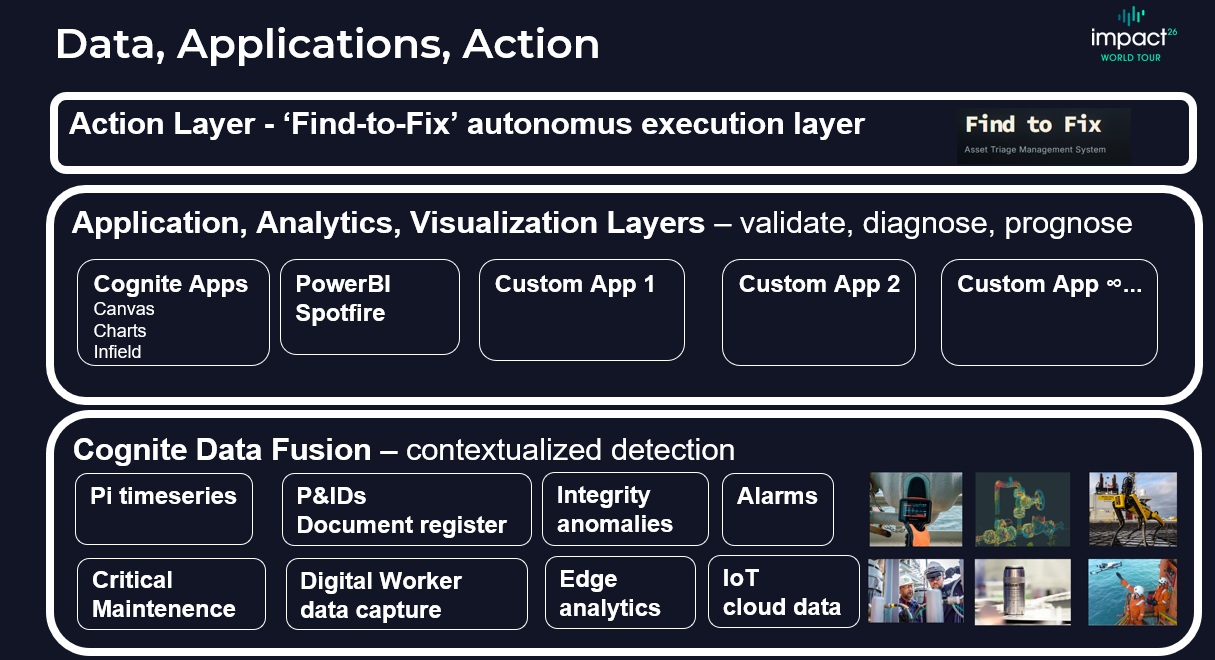
Right before our session, Chirayu Shah (Cognite Chief Product Officer) and Lauritz Lont (Cognite VP of AI) laid out a vision that echoed the theory behind our presentation. We then got to show what that vision can look like in practice. They showed the perfect visualization of what the technology stack looks like for an industrial operation — one we had been trying to demonstrate to our leaders for the last few years, with much poorer graphics.
By the time we got up, the setup was almost too perfect. The presentations before us had all pointed to the same basic idea: this was not about buying a platform, building another dashboard, or chasing digital transformation as a buzzword. It was about creating the conditions for a different way of working.
Our presentation focused on what happens when that vision hits the real world of operating an asset: the people, the data, the workflows, the legacy systems, the good pilots, the stalled pilots, and the constant pressure to prove that digital work actually moves the business.
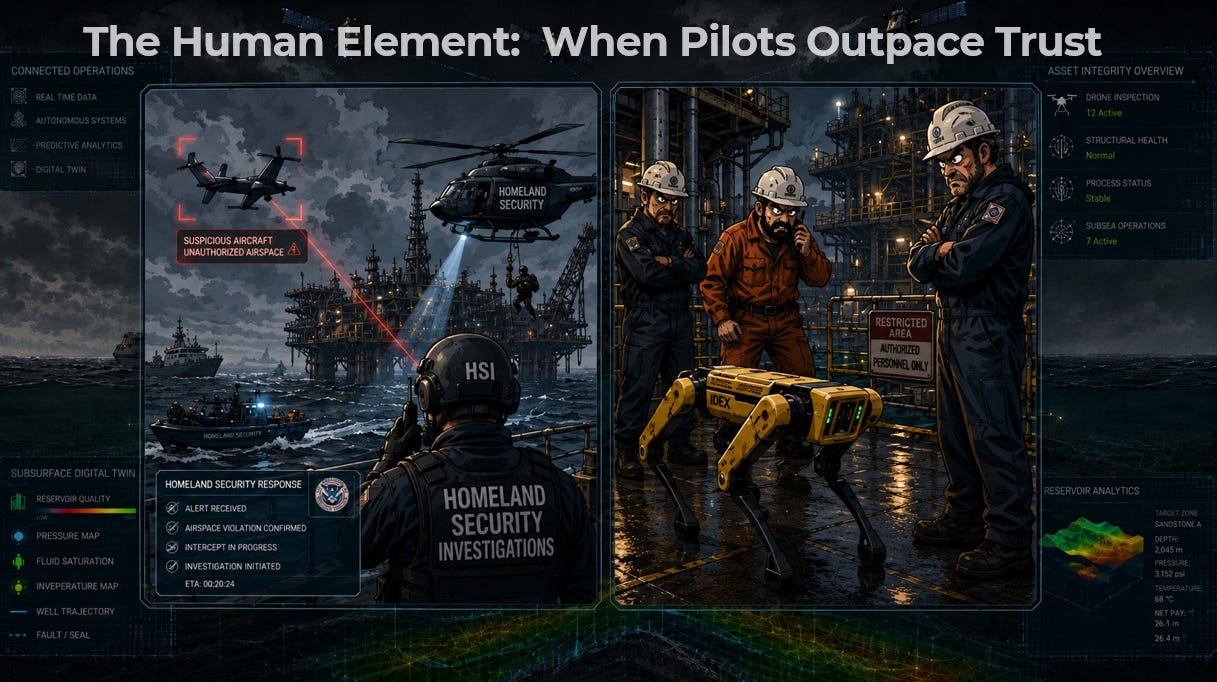
Jacob talked about how we initially ran disconnected pilots that were not always tied clearly enough to business goals. A technology pilot can be technically sound and still struggle if the people closest to the work do not understand the “why.” He shared the story of how we almost had the Department of Homeland Security called on us because the timing and communication were off for a fixed-wing emissions capture pilot. We also discussed how much work it took to recover credibility after that and after the robotics fiasco with Spot, the Boston Dynamics robot dog.
Depending on how it is communicated, offshore robotics can be seen as a useful tool, a distraction, or even a threat. Business transformation is not only a technical exercise. It is also a trust exercise across all stakeholders.
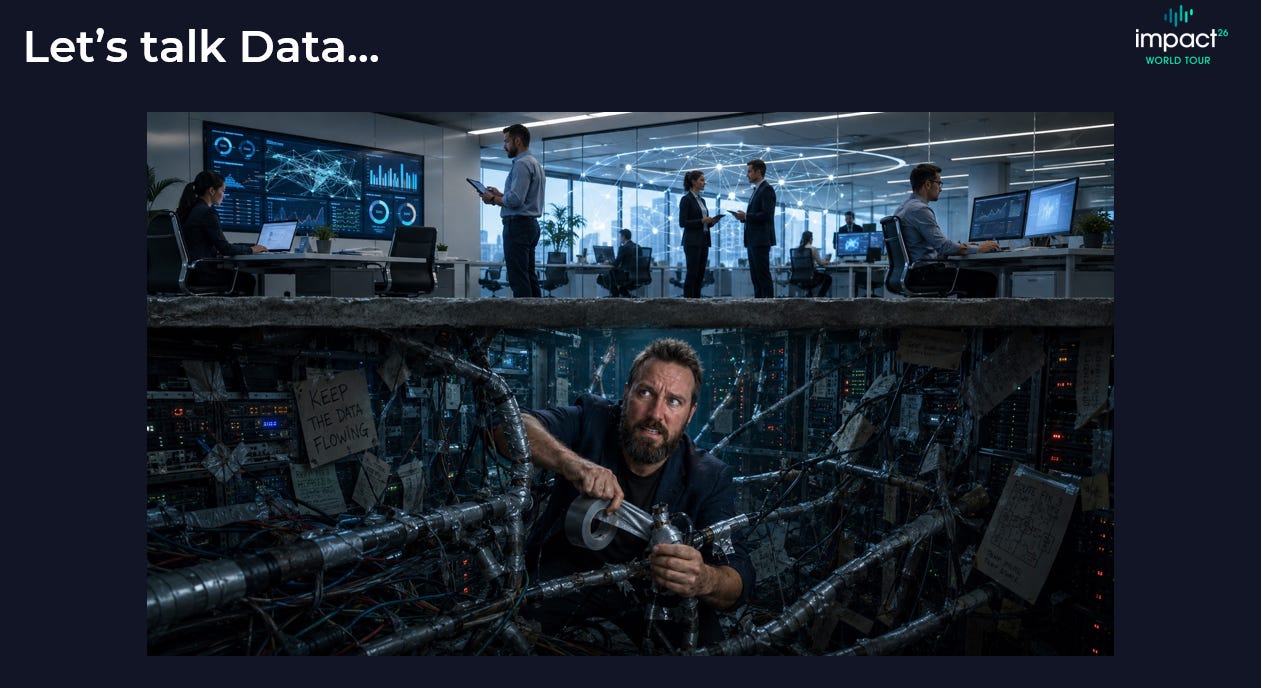
The important point about the data foundation is that it was never just about storing more data. We already had plenty of data. Today, oil and gas companies probably use only a fraction of the data they generate. Useful information was spread across historians, SAP, documents, inspection systems, spreadsheets, engineering tools, field notes, and in people’s heads.
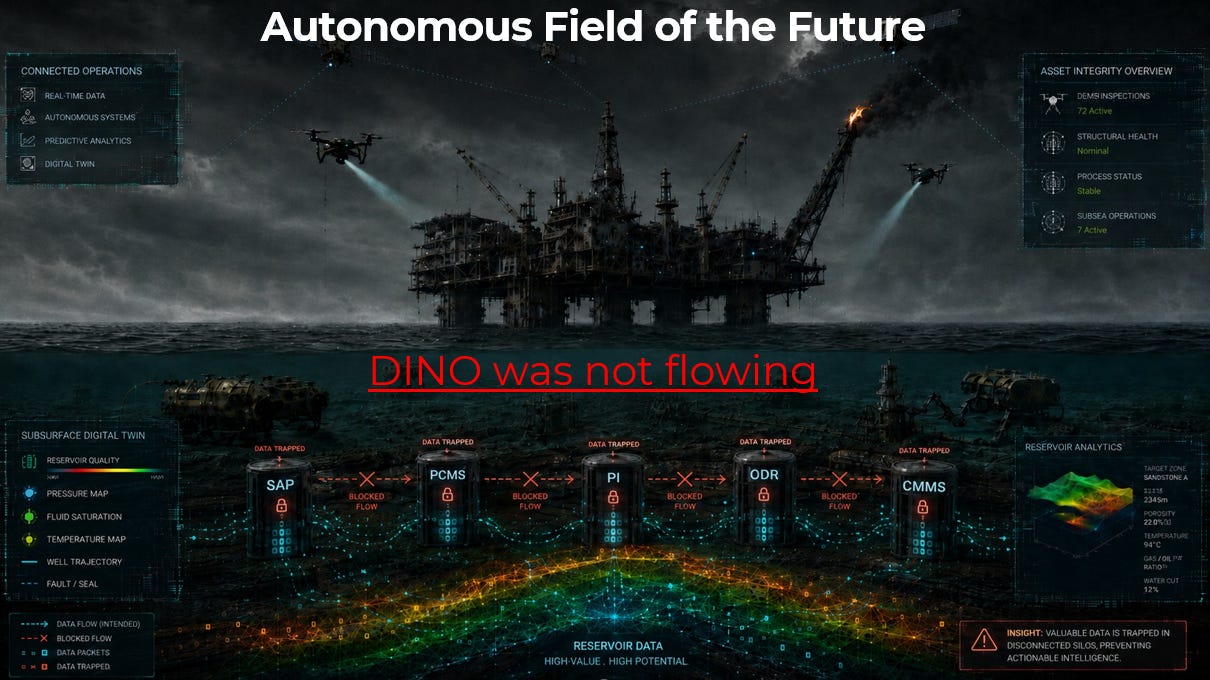
Pilots could prove a concept, but they could not scale into daily operations if the data needed to support them was trapped in disconnected systems. Equipment needed context that could connect time series, P&IDs, documents, SAP events, maintenance history, integrity anomalies, inspections, operator observations, and workflows.
That is when industrial data starts to become useful — not because it sits in one place, but because it begins to reflect how the asset actually works.
An offshore asset has only so many ways to create value.
For an aging offshore asset, the business case was pretty simple: produce more, spend less, spend smarter, avoid failures, and find production opportunities that were already there but not obvious.
We were looking at sensors, robots, computer vision, vibration data, drones, and AI. Not because the technology was interesting on its own, but because any one of those could produce an initial signal to help us protect uptime, reduce OPEX, make better decisions, and find “zero-cost barrels” hidden behind constraints, suboptimal configurations, or missed signals.
These signals could be the initial step into an operating philosophy that we call Find-to-Fix.
Find-to-Fix is simple in concept: detect an issue or opportunity, validate it, diagnose it, prioritize it, execute the corrective work, and learn from the outcome. The hard part is making that happen across real people, real systems, real assets, and real workflows.
We tested technologies that could help the asset sense and perceive more of what was happening.
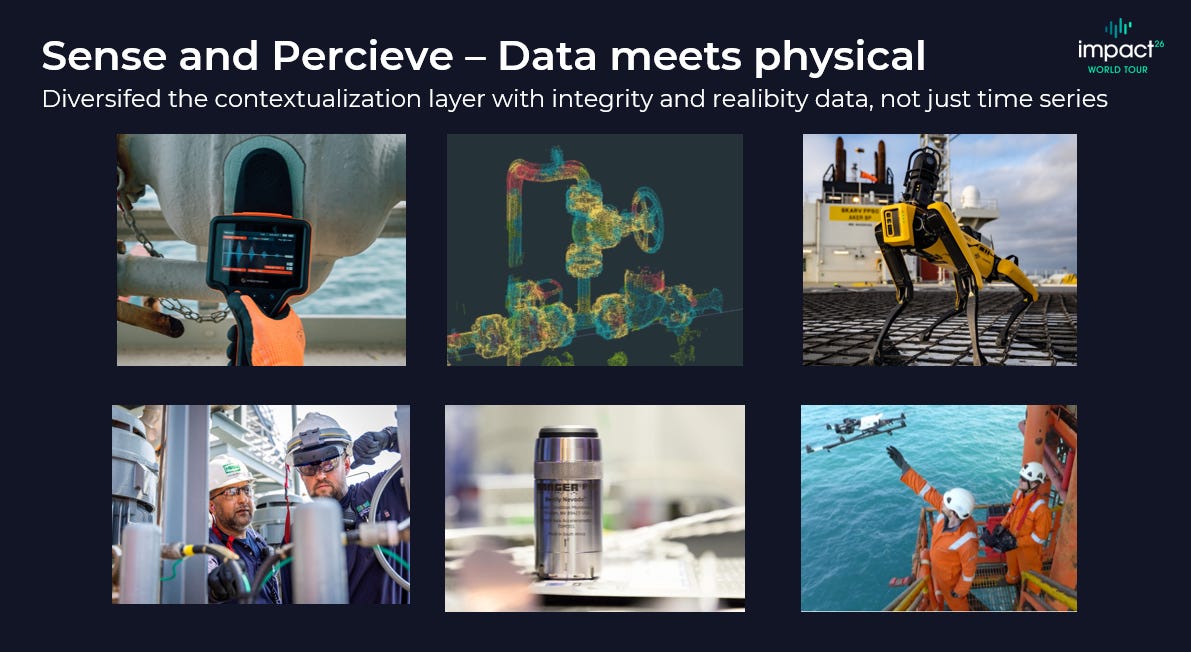
• Remote SME support with Microsoft HoloLens
• Computer vision for fabric maintenance and structural integrity detection with Abyss
• Automated wall thickness monitoring with Inductosense
• Predictive vibration monitoring with RangerPro
• Drones and robotics to reduce rope access hours, taking people out of harm’s way during dangerous inspections
Not every pilot was perfect, but perfection was not the point. The more important question became: can this data connect to the foundation and become part of a connected operating system?
Once the foundation was in place, Cognite native applications helped us test that theory.
• Infield digitized operator rounds and captured more than 100,000 field entries in the first year.
• Remote helped visualize integrity anomalies in context.
• InRobot supported robotics trials with 3D mapping to collect critical data.
• Industrial Canvas helped our organization standardize root cause analysis. In fact, we created a business rule that all RCAs must be completed with the tool.
• AtlasAI queried our workorders to help find similar patterns in detect notifications and workorders
• We also started exploring Maintain to better support work planning during shutdowns and turnarounds.
Those applications proved real value, but they also exposed the next bottleneck.
It was easier to use the native applications because they were “cyber-blessed,” but the custom applications that could take us to the next level of action in Find-to-Fix were still hard to progress. They were slow, expensive, and forced to move through IT, cyber, supply chain, logistics, communications, and all the normal friction inside a large company.
We routinely challenged the system.
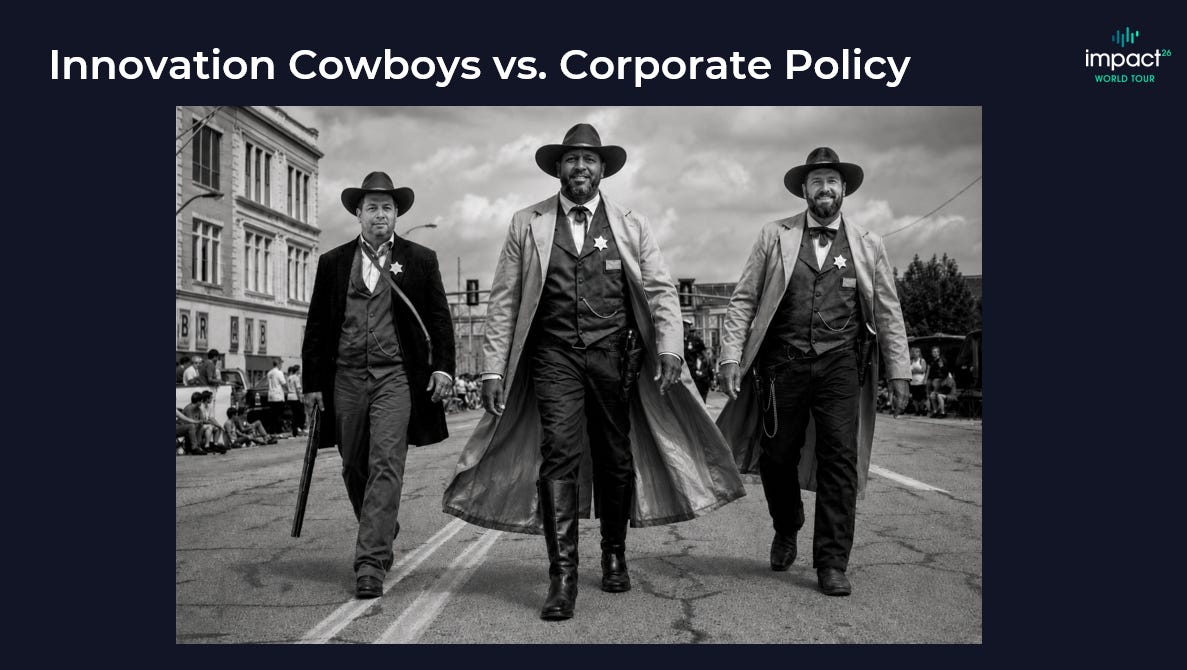
We became the “innovation cowboys,” fighting existing corporate institutions that could not keep up with the pace of digital innovation.
We introduced multiple custom to semi-custom solutions:
· a physics-informed neural network surrogate model for gas lift optimization which delivered production uplift.
· a visualization / engineering workbench that put reliability and integrity in plain view with SLB Optisite
· an executive asset scoreboard which kept leaders abreast of the financial and safety metrics of the asset with IQumulus
The data was there and the value was real, but the path to absorb, scale, and tell that story was harder than it should have been.
We were not being reckless. We were bringing awareness to the tension that exists when trying to move at the speed of bettering the asset versus systems designed to move at the speed of policy. Every company says it wants innovation, but the corporate immune system around innovation often struggles when something does not fit the normal path.
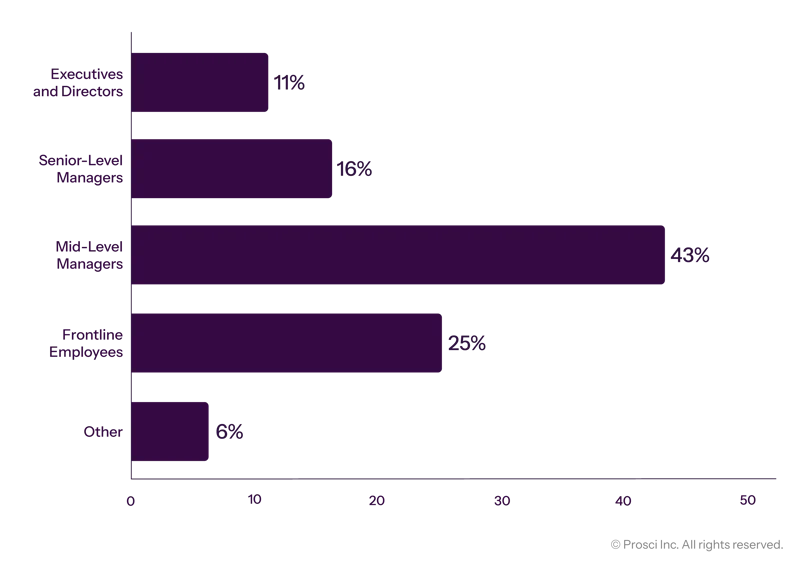
We later recognized the importance of the human side of change management and began incorporating these principles after attending Prosci’s change management program, which helped us communicate ideas more effectively and implement initiatives more smoothly.
We even learned there was a better word for “haters” — it was something like “resistors.” Hahaha
Most resistant groups inside an organization
Back to Find-to-Fix…
Find-to-Fix might start with an operator capturing an abnormal condition in the field or a sensor detecting a change in vibration. In the old way of working, that signal could die in a note, sit in a spreadsheet, get buried in email, or wait for the right person to connect the dots, never making it to fix.
In a Find-to-Fix workflow, that signal is detected and validated against adjacent contextualized data.
Detect → Validate → Diagnose → Prioritize → Execute → Learn
• Detect / Validate:
The workflow can use “sense and perceive” inputs to identify anomaly signals and check whether adjacent data also points to a problem.
• Diagnose / Prognose:
Initiate root cause analysis, query previous instances using GenAI, and draw from analytics, lessons learned, and contextualized work orders to understand the issue and recommend the best path to fix it.
• Prioritize / Execute / Learn:
Work can be prioritized based on risk, production impact, mean time before failure, cost, time, and resource availability. The corrective action can then progress into planning and execution, and the outcome can be captured as a lesson learned so the next Detect → Validate → Diagnose cycle gets better.
Cognite Flows showed us a path to create an application that fit our operating model.
It showed a path to build the kind of custom industrial applications we had been trying to create for years, but at a very different speed — and with a lot fewer people calling us cowboys and more people recognizing us as innovators.
Richard’s demo brought the story full circle: a Find-to-Fix application built on top of the data foundation, connected to workflows, context, and decision logic.
It does not mean every problem is solved. Trust, process, governance, and engineering judgment are still required. But when the foundation exists and the application layer can move faster, the conversation changes.
Ideally, you can now go to Gemba (for us it was offshore), have a human-centered discussion about how data is used, what additional context is needed, and what would make decisions easier for the OIM, operator, or mechanic — then turn around a minimally viable product by the next business day.
Cognite customers can move quickly, test ideas, and turn operational insight into working tools without waiting for the traditional machinery of enterprise software development to catch up.
For field-minded problem solvers, it is hard not to see the appeal.
That is also why the combined strength of our companies Pontem, Iron Stag Advisory, and Genesis Lone Star is worth paying attention to. We all have teams behind us that understand how to work as one when the problem demands it. Together, we can help companies move beyond digital ambition and start solving real operational problems with practical tools, strong engineering context, and people who understand the field.
Flows is a cowboy’s dream.
Find-to-Fix is what becomes possible after the foundation is built.
Link to our full presentation:
 | A guest post by
|
 | A guest post by
|